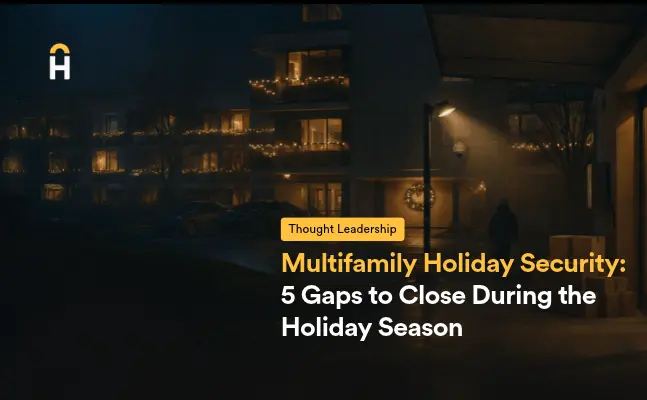
Thanksgiving weekend is when your property goes quiet.
The leasing office closes, maintenance takes time off, and residents leave town. With fewer people around, security issues slip by. A door that doesn't latch, a side entrance left unlocked, or an unfamiliar person in the garage may not get the attention it would on a normal weekday.
Across the holiday season, the data points the same way. FBI Crime Data Explorer figures show U.S. property crime running roughly 11% to 15% higher in December than in other months.
It matters beyond the season, too. In Zego's 2026 survey of multifamily renters and property managers, renters named security concerns among their top three reasons for not renewing a lease.
So before the long weekend, ask yourself: if something happened at your property tonight, would your current setup catch it? And who would respond?
Here are five holiday security gaps worth checking before the season gets busy.
Operating in Canada? Thanksgiving has already passed, but Christmas and Boxing Day bring many of the same staffing and coverage challenges. These checks apply there, too.
You can start with these checks regardless of the security systems you use:
Around 2 a.m., three people in hoodies and ski masks tried to sneak onto a property. Hakimo flagged them and played an automated warning over the speakers, and they turned and ran off.
On a holiday weekend, that 2 a.m. stretch can last for days: nobody on site, nobody watching, and a door that doesn't latch, or one propped open for guests, makes it easier.
What to check:
Hakimo works with your existing cameras and supported access control systems to flag people on the property after hours and forced-door events. Operators can warn them over your speakers or escalate to your team.
Most properties have cameras. What they don't have is someone looking at them at 3 a.m. on Thanksgiving.
A night guard helps, but a guard covers one spot at a time, and holiday shifts are hard to fill. So before the weekend, name one person per day to take the call, plus a backup with a phone number that works on a holiday. Then send a test alert and see who actually gets it. While you're at it, confirm the cameras are recording, that retention will keep Friday's footage through Monday, and that whoever reviews incidents can log in and pull it. If a guard or patrol company covers you, get their holiday schedule in writing.
Remote monitoring covers the gap when your team can't. Hakimo watches your existing camera feeds around the clock, and trained operators review whatever the AI Operator flags. They can use your on-site speakers for a live talk-down, or escalate to your security team. Operators at Hakimo have a median response time of six seconds.
Ana Gonzalez, a property manager at Stockdale Management, puts it this way:

Hakimo is much more reliable than having a night security guard. As a property manager safety is one of my top priorities, and with Hakimo’s live monitoring, I feel like I have an extra set of eyes I can always rely on.
More from property teams in our customer stories.
You probably know this one already, so we'll keep it short. Holiday deliveries land all day, residents are away, and a full package room is hard to keep an eye on. Limit access to residents and authorized staff, and make sure the door closes and locks properly. Check that your cameras show who comes in and out, not just the shelves. Decide where overflow goes, and tell residents to pick up promptly or use delivery holds if they're traveling.
Hakimo can monitor mailroom activity and flag suspicious behavior, like this mailroom incident. For the full rundown, read our in-depth guide, How to Prevent Package Theft in Apartment Buildings.
Quick test: if an alarm goes off at 2 a.m. on Saturday, who gets the call, and what do they do next? If that takes more than a few seconds to answer, you've found the gap.
Most alarm calls turn out to be false alarms. A U.S. Department of Justice guide estimates that 94–98% of police alarm calls are false, with each one taking about 20 minutes of police time, often involving two officers.
That's why many cities push back. Some stop sending officers to unverified alarms altogether, and many charge for repeat false alarms. According to NYU's Policing Project, the City of Chicago imposes a $100 fine per false burglar alarm immediately, and Los Angeles fines $50 after the first false alarm, adding another $50 for each one after that. Check your own city's rules, then write the plan on one page: who looks, who calls the police, and what they say.
Hakimo verifies an event before it escalates, so when an operator calls police, it's a documented call about something real. That can mean fewer false alarms and fewer 2 a.m. calls about nothing. At one property Hakimo monitors, two people broke in after hours. Hakimo flagged it within seconds, an operator reviewed the footage and confirmed it, and a security officer was dispatched, confronted them on site, and told them to leave. The officer then secured the property.
Entrances get the attention. The rest of the property gets less over a long weekend: garages, fences, side entrances, vacant units, stairwells, and amenity spaces. Residents leave cars parked for days, guests add more people to shared spaces, and empty units and restricted areas can go unchecked.
Walk the property before the holiday the way a stranger would. I'd do the walk after dark. Lighting gaps and blocked camera views only show up once the sun's down.
Hakimo monitors supported camera views across parking areas, garages, and other shared spaces to help operators spot perimeter breaches, unauthorized access, and dumpster misuse. In one fence-hopping catch, three people climbed over a fence into a property, Hakimo flagged it, and security removed them.
If trash dumping is a recurring problem, see our trash and dumping solution.
Not every holiday-related risk fits neatly into the five gaps above. Three more are worth a look before the weekend.
For portfolio managers, holiday security is also an operational and financial consideration. An incident can mean a resident complaint, an insurance claim, property damage, or a tough conversation at renewal, and with fewer people on site it may take longer for anyone to notice.
Before the holiday, ask a few questions across your properties.
Hakimo's remote guarding is designed to work with your existing cameras and can reduce how much on-site guarding a property needs, depending on its coverage needs and operating model. Hakimo estimates potential annual savings of $125,000 to $750,000 compared with traditional guarding in some deployments. Actual savings depend on staffing, property size, and coverage model.


Start with three things: walk the entrances and perimeter after dark, check that every camera feed is live, and decide who takes the call if something goes wrong. Then make sure someone is actually watching the feeds, since cameras alone only record what already happened.
Holiday weekends bring together several factors that make a property easy to overlook: the leasing office is closed, staff are away, many residents are traveling, and deliveries keep arriving. With fewer people around, fewer people notice an unlocked door, someone in the mailroom, or a stranger in the garage.
Hakimo's AI Operator watches for anything your team can describe in words, including package thefts, break-ins, trespassing, loitering, unauthorized access, after-hours amenity use, trash dumping, slips and falls, and smoking violations. It can also detect weapons through your existing cameras. What counts as an incident is set by your team, so over a holiday weekend you can flag exactly what matters at your property, like someone lingering in the garage or using a closed amenity space.
Security isn't a holiday problem. The holidays just show you where your coverage was thin.
Check the doors, test the camera feeds, look at the package room, and decide who answers when an alert comes in. Do that now and Christmas and New Year's get easier too.
If you want to see how this would work across your multifamily portfolio, book a demo with Hakimo. It can run on the cameras you already have, with trained operators reviewing what the AI flags.
Not ready for a demo? Read how property teams use AI incident response to reduce liability risk.

Anju George is a Content Marketer at Hakimo with five years of experience, mostly in B2B SaaS. She writes about AI-powered physical security for property owners and operators across multifamily, hospitality, student housing, automotive, and construction. Whether it’s package theft, vandalism, or a security budget that won’t stretch any further, her goal is to help readers leave with something they can act on.