


.svg)


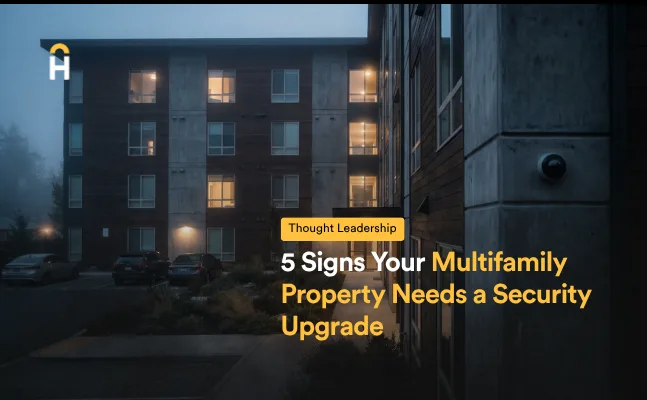
Ask a multifamily asset manager how their security is performing, and you'll usually get an answer in inputs like number of cameras, guard hours, or whether the alarm system is "active."
Well, that's actually a weird unit of measurement.
Security is the only major operating expense most owners measure by what they're buying instead of what it's doing. You'd never evaluate marketing by counting ads run, right? You'd look at deals closed. You'd never evaluate maintenance by counting work orders but you'd look at unit turn time.
But security still gets measured by hours-on-site and equipment-in-place, neither of which tells you whether anything was actually prevented.
So the category grows on autopilot. Guard rates climb because the labor market is structurally short. false positive fines stack up. Camera systems expand after every incident, even though more cameras don't fix the real problem.
The shift the smartest operators are making is simple: stop measuring presence, start measuring outcomes.
If you manage or own multifamily assets, here are the five signs that should make you pause and ask whether your security setup is still earning its place on the P&L.
Here are five signs your current setup is no longer pulling its weight, and what to do about each one.
Go to any multifamily property and ask the on-site manager about security, and you'll usually hear some version of: "We've got cameras everywhere." (said with a kind of grim pride.)
The issue is: ‘cameras fitted everywhere’ isn’t a security strategy. It’s like you’re just documenting events that are taking place.
In simple terms, a traditional CCTV setup captures footage. It doesn't intervene, or talk back, or prevent something from happening. And by the time someone reviews the recording, usually the next morning after a resident files a complaint or maintenance finds a smashed window, the suspect is long gone and the loss is already on the books.
And that's a real gap.
The average burglary lasts about eight to ten minutes. If nothing happens in that window (no detection, no escalation, no live response), your cameras aren't really doing security work but sadly, just collecting evidence for an insurance claim.
What a real upgrade looks like
This is where AI-powered monitoring fundamentally rewrites the equation. Hakimo's AI Operator plugs into your existing cameras and watches them around the clock, not as a recording device, but as an active set of eyes.
When it spots a real threat, it doesn't wait. It can trigger a 120-decibel live talk-down through on-site speakers, often deterring someone before the incident becomes one. Median response time across Hakimo-monitored sites? Six seconds.
This one rarely shows up on anyone's radar until it becomes a real problem. According to industry analysis, up to 98% of security alarm dispatches are false, and major cities have already noticed this trend.
Seattle now requires supporting evidence (audio, video, or eyewitness testimony) before dispatching officers. Houston enforces non-response after a set number of false positives from the same address. Baltimore dropped its allowable false-alarm threshold from five to two before cutting off response entirely. Chicago charges $100 per false positive with zero tolerance.
Across a portfolio, those fines stop being annoying and start being a real line item. But the deeper risk is reputational: if your address gets blacklisted, you're paying for an alarm system that no longer summons police.
And that’s real: Baltimore actively maintains a registry of high-frequency false-alarm locations.
What a real upgrade looks like
AI-based filtering is one of the most overlooked cost savers in the entire security category.
Hakimo verifies events before anything escalates, so when its operators do call police, the alarm is real, the threat is documented, and law enforcement treats it as a high-priority dispatch.
In short, with Hakimo by your side you get fewer fines, faster response when it matters, and no risk of getting blacklisted.
Traditional guarding is quietly broken. As per recent industry reports, security guard turnover sits between 100-400% annually. Plus, reports show that over 60% of security service providers cite rising hourly pay rates as their top operational challenge, with labor shortages close behind.
This means the guard you onboarded in the spring is probably gone. The new one doesn't know which residents live where, which side doors stick, or what time the recycling truck rolls in. Familiarity is the single most valuable thing a guard brings, and the industry has structurally lost the ability to provide it.
A single full-time on-site guard, once you add up wages, overtime, benefits, agency fees, and the time your property manager spends managing schedules, can cost up to $275,000 a year. Most properties need more than one. And even then, guards take breaks, get sick, and can only be in one place at one time.
The pattern most asset managers describe is the same: more guard hours, more cost, same incident count (sometimes worse.)
What a real upgrade looks like
Roxane Bernhard, a Senior Property Manager, put it plainly: "Hakimo's ability to actively watch activity as it occurs has been huge, we're securing our buildings at a third of the cost."
Hakimo doesn't replace human judgment; it replaces the part of guarding that's actually a monitoring task. Trained operators stay in the loop and escalate only when something genuinely matters. Your community manager stops spending half the day managing shift coverage and starts spending it on leasing and renewals.
Here's something that doesn't show up in a security audit but absolutely shows up in your operating statement: when residents stop feeling safe, they stop renewing.
The top three safety concerns among multifamily property managers are vehicle break-ins, package theft, and trespassing, exactly the kinds of incidents that play out in shared spaces like garages, mailrooms, and side entrances. Of course, not those headline-grabbing crimes but the slow drip that erodes resident confidence over weeks.
One break-in to a single car can trigger a wave of move-out notices. A package theft trend in a building's lobby will show up on Google reviews within a week. And once a property gets labeled "unsafe" in resident-facing apps or in renter forums, you lose the prospects who never tour the building in the first place.
The financial drag compounds fast. Industry analysis shows that properties with rising crime face higher vacancy rates, reduced rent growth, and higher insurance premiums. Every dollar you "save" by underinvesting in security usually returns as three dollars of leakage on the revenue side.
What a real upgrade looks like
Visible, active monitoring is a renewal lever, not just a cost.
Vincent Favata of Tangram Group described the shift well: "What makes Hakimo different is that proactive intervention capability. Instead of reacting to problems after they've escalated, you can actually now prevent them." Residents notice the difference quickly. So do prospects on tour.
Ask whoever runs security at one of your properties three questions:
If the answers come back as generic hours-on-site reports, the security model is opaque. And opaque security is expensive security.
This is the structural shift happening in physical security right now. The old model billed for presence. Hours on site, cameras installed, alarm permits maintained. The new model bills for outcomes. Threats detected, incidents prevented, false positives eliminated, and residents retained.
In a year when 74% of apartment owners say operational efficiency is their biggest challenge, opaque cost centers are the first thing being cut.
What a real upgrade looks like
Outcome-based security is measurable security. Hakimo gives portfolio operators a clear view of incidents detected, talk-downs delivered, threats deterred, and false positives filtered.
In that 15+ property portfolio we mentioned earlier, the measurable outcome was a $2.5M net NOI impact, 3.5x ROI, and a 3.4-month payback period. Numbers like that only exist when you can actually measure what your security is doing.
If you recognized even two or three of the signs above, the next question is the practical one: What does an upgrade actually involve?
Well, it doesn't involve ripping out your existing cameras. That myth (that AI security requires a hardware overhaul) is one of the biggest reasons asset managers delay the decision.
The reality however, is just the opposite.
AI-powered monitoring platforms work with the infrastructure you already have. Hakimo, for example, integrates with any ONVIF-compliant camera and offers direct integrations with leading VMS, access control systems, and audio speakers like Axis. Quick deployment and absolutely no learning curve is what makes it the best. Now, what changes is what those cameras are doing. Instead of passively recording, they're being watched in real time by an AI Operator trained to tell the difference between a real threat and a delivery truck.
When something legitimate happens, a verified alert reaches a trained human operator within seconds, and the response is immediate. A talk-down through the on-site speaker, or a verified dispatch to law enforcement, or an alert to the property manager.
The shift is simple: from being reactive to being proactive.
Security isn't really a budget problem.
The operators who recognize that early are the ones whose properties stay full, whose insurance premiums stay manageable, and whose residents stay long enough to renew.
If you're spending more on security every year and getting roughly the same outcomes (or worse), that's the signal.
Book a demo with Hakimo and see what proactive, AI-powered monitoring would actually look like across your portfolio. The first conversation usually takes less time than your next guard schedule meeting, and it might be the last time security shows up on your P&L as a line item you can't explain.
.png)
.png)




.svg)
.svg)





.webp)


.png)

